To
An odd EM wave
A memoir of Engineering Persistence and Human Discovery
Reminiscences on the human dimension of an engineering career.
Charts an unconventional engineering career spanning multiple continents and decades, offering insights rarely found in traditional engineering literature.
It starts at the age of 15 on a building site in England and ends, as described by a reviewer, as a distinguished engineer
A reviewer describes it as both heart warming and heart breaking.
It serves as an inspiration and a practical roadmap.
D. A. Weston
At the front desk of the Medical Research Council Neuropsychiatric Research Unit where I worked was a scrap book which in which as well as describing interesting scientific finds was a piece about Vatslav Nijinsky describing him as the famous schizophrenic completely ignoring him as the famous ballet dancer and choreographer.
Nijinsky choreographed L’apre-midi dun faune (The Afternoon of a Faun) 1912, Le Sacre du Printemps (The Rite of Spring )1913, Jeux 1913, Till Eulenspiegal1 1916.
Nijinsky’s work was considered daringly original and broke with traditional ballet. His angular movements expressed the modern scores of the time.
Bronislava Nijinska, Vatzlav’s sister, describes his dancing as follows: Throwing his body up to a great height for a moment, he leans back, his legs extended, beats an entrechat-sept in the air, and, slowly turning over onto his chest, arches his back and, lowering one leg, holds an arabesque in the air. Smoothly in this pure arabesque, he descends to the ground…. From the depths of the stage, with a single leap, assemblé entrechat-dix, he flies towards the first wing.”
[note]Bronislava Nijinska describing Vaslav Nijinsky’s Paris debut in
Michel Fokine’s “Le Pavillon d’Armide,” from Bronislava Nijinska: Early
Memoirs, trans. Ed. Irina Nijinska and Jean Rawlinson (California:
Holt, Rinehart and Winston, 1981), 270-271[/note]
Vaslav Nijinsky could hover in the air; such was his art
(California: Holt, Rinehart and Winston, 1981), 270-271note]. Most modern dancers can only achieve a entrechat six, not an entrechat dix and so because of the huge difference between a six and a ten the question of if this was an exaggeration must be asked. The myth that his heart had to be restarted every time he jumped through the window in the spectre de la rose must be untrue. The ballet became famous for Nijinsky’s leap through one of the two large windows at the back of the stage. Despite appearances to the contrary and Nijinsky’s athletic grace and prowess, the height of the leap was an illusion. Nijinsky took five running steps from the middle of the stage and leapt through the window on the sixth step. The skirting board (base board) under the window was very low, giving the illusion that the leap was higher than it actually was. Behind the set, four men caught Nijinsky in the air and immediately shrouded him in warm towels. No one in the audience ever saw Nijinsky land, so the elaborate arrangements gave the impression that he soared on indefinitely. The illusion was helped by the conductor in the orchestra pit who held the penultimate chord. In doing so, the leap was given a sense of greater length and height. It was said that Nijinsky’s legs looked like frog’s legs and so this might have been the reason for his
A photo shows Nijinsky in a mental hospital in England leaping in the air and so they made a spectacle of him.
Also, the young Nijinsky could jump so high into the air that he seemed to hover there. He would dance ‘like a girl’ – dancing en pointe was almost unheard of for a male dancer of his era; he would dance with his feet turned out, hammering the stage at terrific speed; he invented his own steps and his own rules. He gained fame dancing for Diagilev and the ballet Russe.
The Ballets Russes radically transformed the nature of ballet its subject matter, movement idiom, choreographic style, stage space, music, scenic design, costume, even the dancer’s physical appearance. From 1909 to 1929, it nurtured some of the greatest choreographers in dance history Fokine, Nijinsky, Massine, and Balanchine
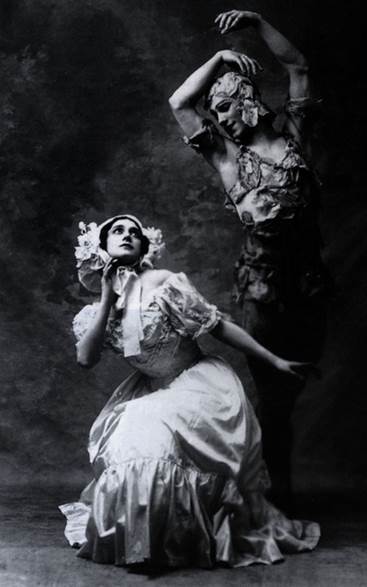
Nijinsky and Karsavina in La spectre de la rose.
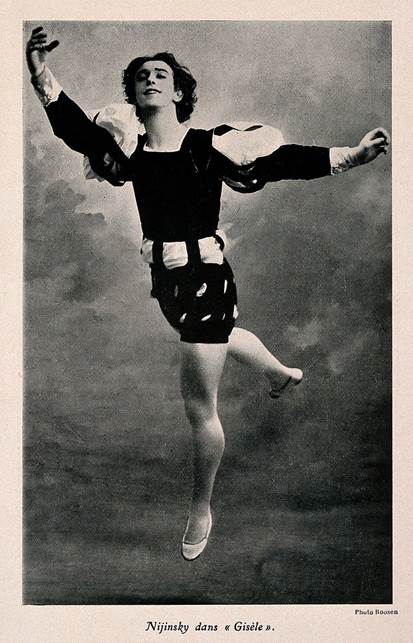
Nijinsky leaping in Gisele.
 EMC books